Thinking Fast and Slow vs Decisive vs Thinking in Bets
Three decision-making books compared: how each teaches, what you can use tomorrow, how the evidence holds up, a scorecard out of 50 and a reading order.
Synthetic voice (Gemini TTS); the host is an AI-made illustration; research and script are original.
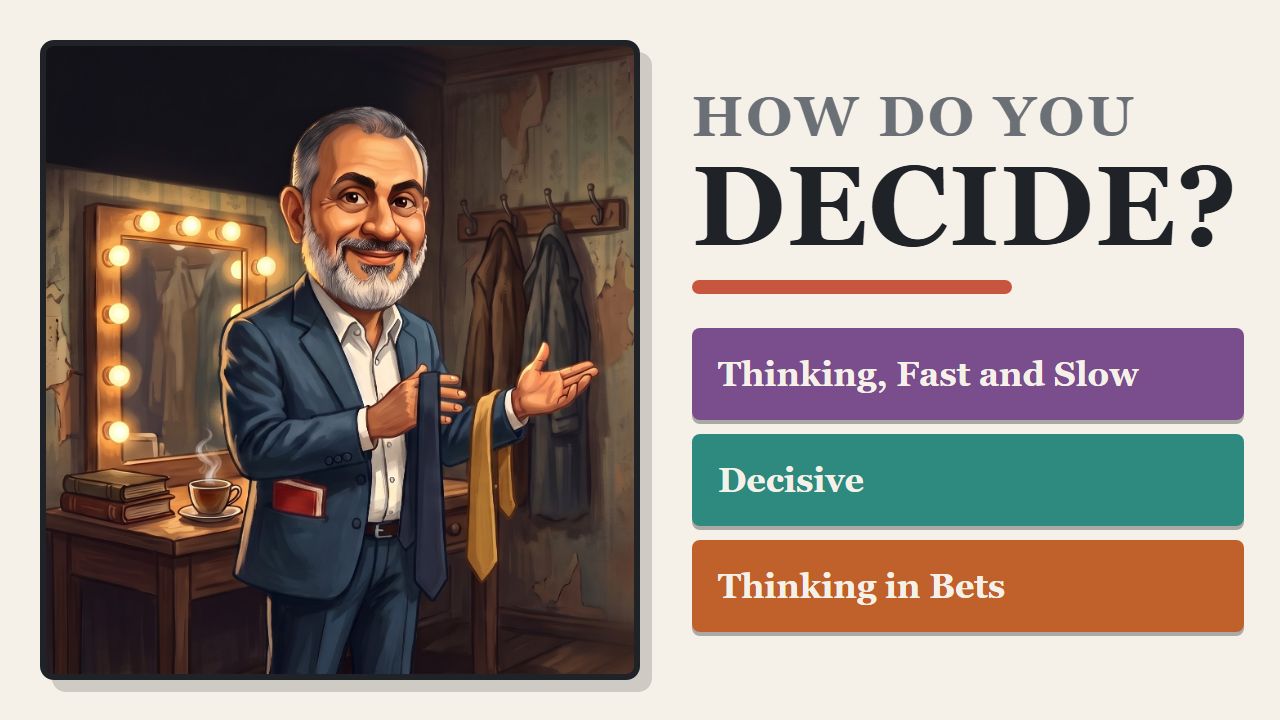
The books
Thinking, Fast and Slow
Daniel Kahneman · 2011
39/50 top score
Best for: The reader who wants to understand why minds go wrong: the richest and best-evidenced of the three, and the heaviest read.
Find on AmazonDecisive
Chip Heath and Dan Heath · 2013
37/50
Best for: Someone with a real decision on the table: one process, tools with concrete wording, and the easiest read.
Find on AmazonThinking in Bets
Annie Duke · 2018
35/50
Best for: Anyone judging past decisions or deciding in a group: it owns the decision-versus-outcome distinction.
Find on AmazonScorecard
| Criterion | Thinking, Fast and Slow | Decisive | Thinking in Bets |
|---|---|---|---|
| Style & ease | 6 | 9 | 8 |
| Information | 9 | 7 | 6 |
| Uniqueness | 9 | 6 | 8 |
| Presentation | 7 | 9 | 6 |
| Documentation | 8 | 6 | 7 |
| Total (/50) | 39 | 37 | 35 |
Try this before you read on. A disease threatens six hundred people. Plan A saves two hundred for sure. Plan B gives a one-in-three chance that everyone is saved and a two-in-three chance that nobody is. Which do you pick?
Now the same disaster, reworded. Plan C: four hundred people die for sure. Plan D: a one-in-three chance that nobody dies, otherwise all six hundred die.
A and C are the same plan, and so are B and D. In the study Kahneman reprints, 72% of one group (152 people) took the sure option, while 78% of another group (155 people) took the gamble (Thinking, Fast and Slow, ch. 34 and Appendix B). Same arithmetic, opposite choices. That puzzle is the reason three very different books on decision-making exist, and we read all three to see how each one teaches, what you can use tomorrow, and how well each stands up to the research.
Two systems, and why the puzzle fools us
Kahneman's explanation is the best-known picture in the field. System 1 operates automatically and quickly, with little effort. System 2 does the effortful mental work: checking, calculating, concentrating. The catch is that System 2 is often lazy, and tends to endorse System 1's impressions instead of examining them (ch. 1, p. 22; ch. 3, "The Lazy Controller").
Apply that to the puzzle. The fast system picks by the wording: "saved" sounds safe and "die" sounds frightening. The slow system could check that A equals C and B equals D, but usually it signs off on the first impression. Nothing is wrong with your arithmetic; the check simply never runs.
What should you do about it? Kahneman's advice, in the Conclusions (p. 407), is to learn to recognise the signs that you are in a cognitive minefield, slow down, and ask for reinforcement from System 2. He is candid that this is hard: "little can be achieved without a considerable investment of effort" (ch. C, p. 407).
Two details are worth knowing. First, Kahneman says the two systems are "fictitious characters", useful nicknames, and that no part of the brain is either system's home (ch. 1, p. 31). Second, the other two books use the picture in their own ways, and they frame it differently:
- Thinking in Bets borrows the two-system picture and credits Kahneman. It then goes a step further and places the automatic system in evolutionarily older parts of the brain and the deliberative one in the prefrontal cortex (ch. 1, p. 17-18).
- Decisive builds on Kahneman's "what you see is all there is" and renames it the "spotlight" effect (intro, p. 7-8).
That is a difference in framing, not a dispute. Kahneman presents the systems as a way of talking; Duke ties them to brain regions; the Heaths repackage one of the consequences as an image you can remember. Where the books really part ways is what comes next. Kahneman says to slow down. The other two turn "slow down" into tools: WRAP, the premortem and 10/10/10 in Decisive, and Duke's work-arounds in Thinking in Bets. Keep that in mind for the sections below.
What each book covers
Thinking, Fast and Slow (Daniel Kahneman, 2011) is the biggest and the deepest: thirty-eight chapters in five parts. Its author had already won the 2002 Nobel in economics. Its strengths are that it teaches by participation, names its studies and often their sample sizes (Tom W, N = 114, ch. 14, p. 147; Meehl's roughly 200 studies; Tetlock's 284 experts), and is honestly self-critical. Its second half holds real procedures, including the outside view (ch. 23) and the premortem (ch. 24). The cost is length: it is the heaviest read of the three, and its advice is scattered across about fourteen chapters with no consolidated checklist.
Decisive (Chip and Dan Heath, 2013) maps four "villains" of decision-making, narrow framing, confirmation bias, short-term emotion and overconfidence, onto four steps: Widen your options, Reality-test them, Attain distance, Prepare to be wrong. Each chapter ends with a one-page summary, and an end-of-book case walks the whole process through one decision in forty-five minutes (ch. 12, p. 233). Its tools come with usable wording, such as the Vanishing Options test (ch. 2, p. 47-49) and "What would have to be true?" (ch. 5). The authors put the core insight well: "Focusing is great for analyzing alternatives but terrible for spotting them" (ch. 2, p. 46). Its limit is that the remedies mostly rest on illustrative stories rather than tests.
Thinking in Bets (Annie Duke, 2018) is built on one idea from a professional poker player: every decision is a bet, and outcomes are decision quality plus luck. Its great strength is a distinction no other book here centres: a good decision can have a bad outcome, and judging the decision by the outcome ("resulting") is the trap. It also has the fullest treatment of deciding in groups. It leaves out base rates, anchoring and framing, and has no consolidated procedure.
Same idea, three ways: what you can do tomorrow
One tool from each, all usable the day you read them:
- The premortem (Thinking, Fast and Slow, ch. 24): before you commit, imagine the plan has already failed and write down why. You surface risks while you can still act on them.
- 10/10/10 (Decisive, ch. 8): ask how you will feel about a decision in ten minutes, ten months and ten years. Short-term emotion loses its vote.
- Put a number on it (Thinking in Bets, ch. 2): rate your confidence from 0 to 10 and say it out loud. A stated number can be updated; a felt certainty can't.
Seen through the two-systems picture, each is a way of giving System 2 a job to do before System 1 signs off.
Do they match the experts?
This is where the books separate most. Thinking, Fast and Slow is the best documented of the three, with named studies, sample sizes and full endnotes. Its anchoring and framing figures match the reprinted 1974 and 1981 papers. But two early chapters, on priming and on willpower running out, stated their results with high confidence, and that research was later weakened. A 2016 replication across 23 labs (2,141 participants) found almost no willpower effect. In 2017 a comment posted under Kahneman's name on a research blog said of the priming research, "I placed too much faith in underpowered studies." We call that contested, not debunked, and the core of the book does not depend on either chapter.
Decisive backs its diagnosis with named studies, including Tetlock's 82,361 forecasts and Lovallo and Sibony's 1,048 business decisions, but its remedies mostly rest on stories, and several figures are sourced only in the endnotes. Thinking in Bets rests its core claims on published experiments, but the method itself, the pods, rituals and group rules, has not been tested. None of the three is making things up; they differ in how much of what they teach has survived a test.
The scores, and why they are close
Our totals are 39, 37 and 35 out of 50. The gap is small, and weighting the criteria differently changes the order: for ease and application Decisive leads, for breadth and evidence Thinking, Fast and Slow leads, and for one deep, useful idea Thinking in Bets leads. These are our opinions, relative to these three books.
Which one should you read?
- Want to understand why minds go wrong? Thinking, Fast and Slow. The richest and best-evidenced, and the heaviest read.
- Have a real decision on the table? Decisive. One process, concrete tools, the easiest read.
- Judging past decisions, or deciding in a group? Thinking in Bets. It owns the decision-versus-outcome distinction.
For a first-timer, our reading order is Decisive for tools, then Thinking, Fast and Slow selectively for the why (Part 1 and chapters 11, 14-16, 21, 23-24, 26, 31 and 34), then Thinking in Bets for judging your decisions afterwards. Short on time? Read Kahneman's chapters 1-3 and Conclusions, the Heaths' chapters 1 and 12, and Duke's chapters 1-2.
Whichever you start with, the first step is the one the puzzle teaches: notice when the first answer came too easily.
The authors and publishers are not affiliated with this channel and do not endorse this comparison. Page references follow the PDF pagination of the editions we read. We criticise claims and coverage, not people.
Chapters
- 00:00 Cold open
- 00:32 Welcome
- 01:50 Question one: How does each book teach?
- 04:08 Question two: What can you do tomorrow?
- 05:31 Question three: How does each handle the evidence?
- 07:34 The scorecard
- 08:10 The verdict
- 08:42 Close
Sources
- Tversky & Kahneman (1981). The Framing of Decisions and the Psychology of Choice. Science, 211, 453-458
- Tversky & Kahneman (1974). Judgment under Uncertainty: Heuristics and Biases. Science, 185, 1124-1131
- Hagger et al. (2016). Ego-depletion multilab replication. Perspectives on Psychological Science, 11(4), 546-573
- Schimmack, Heene & Kesavan (2017). Reconstruction of a Train Wreck: How Priming Research Went Off the Rails (Replicability Index blog, not peer-reviewed)